Why certification matters for a floating sauna in the UK
In short:
- Sauna boats and floating saunas are typically treated as vessels under UK maritime law.
- Under UK law, vessels used commercially for recreational purposes (including commercial hire) must be UKCA certified and RCR compliant or be certified under an accepted alternative such as EU RCD.
- Operating a floating sauna commercially without certification may create legal, regulatory compliance, safety and liability risks.
- Waterpod is England's first and only designer and builder of UKCA certified floating sauna vessels, taking vessel certification of compliance responsibility.
If you are a hotel next to a lake, a marina operator, a rowing club, an estate, or a town or city council looking at a floating sauna, the first questions are usually “How nice does it look?”, “How much can it earn?” and “How much does it cost?”.
The critical but often overlooked questions are:
Will this be safe for guests and staff?
Is it certified to meet the safety standards and guaranteed to be compliant by the builder?
Will insurers, councils, harbour authorities and planning authorities be comfortable?
Can it be deployed and operated without endless problems?
That is why certification matters.
In Great Britain, recreational craft placed on the market, or put into service must comply with the Recreational Craft Regulations 2017 and be UKCA marked*.
https://www.britishmarine.co.uk/resources/knowledge-centre/recreational-craft-regulations-rcr
* the UK currently also accepts CE marked vessels under the EU Recreational Craft Directive, if certified by a non-UK builder. This is similar to the UK RCR, but has a different framework and different legal compliance routes.
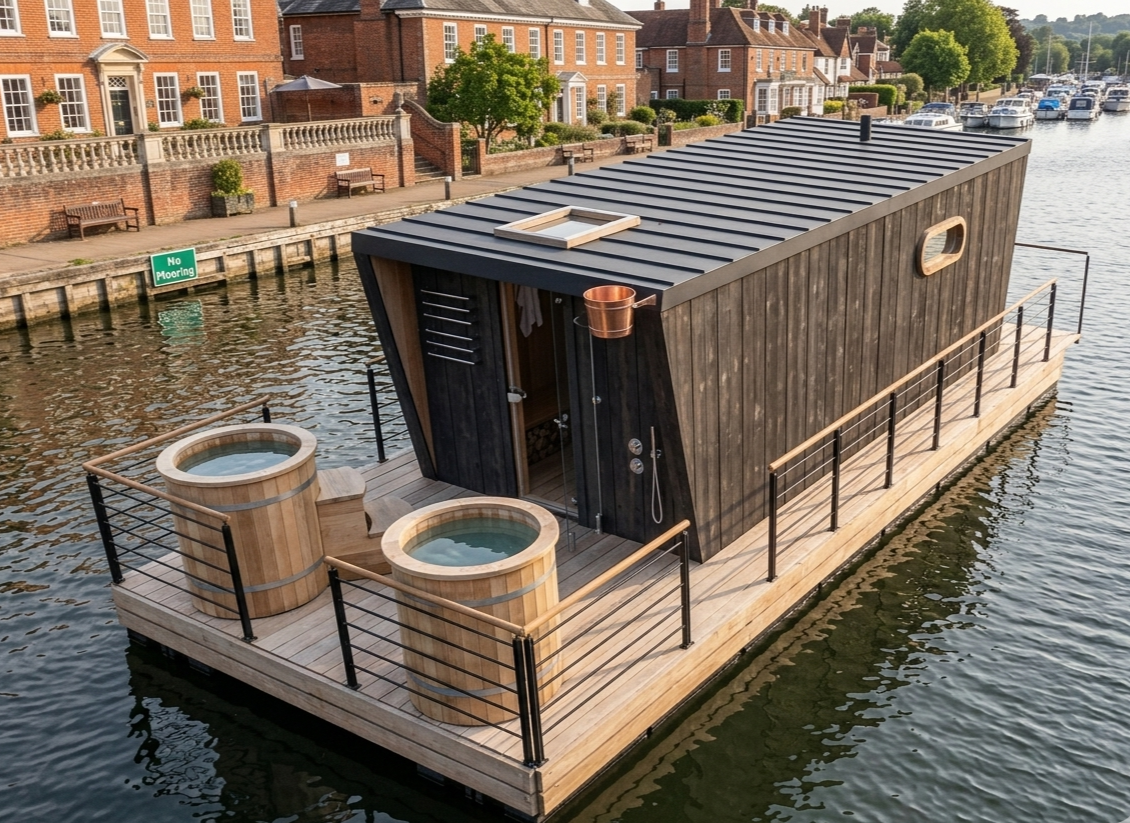
“We’re often asked:
’Can’t I just buy a pontoon, put a sauna on it, and start a commercial floating sauna business?’
The short answer: Usually not legally.”
Why this matters commercially
A commercial floating sauna has to stand up to more scrutiny than a private leisure product.
A hotel owner will worry about guest safety and brand risk.
A marina will worry about whether the installation is credible and manageable.
A council will worry about public safety, liability, and whether the operator is bringing something professionally designed and documented rather than experimental.
That is exactly where certification becomes important.
A properly certified vessel signals that the product has been designed, assessed, documented, and placed on the market through a recognised conformity route. It also means the manufacturer should be able to provide the paperwork, technical documentation, identification details, and safety information that serious commercial buyers expect.
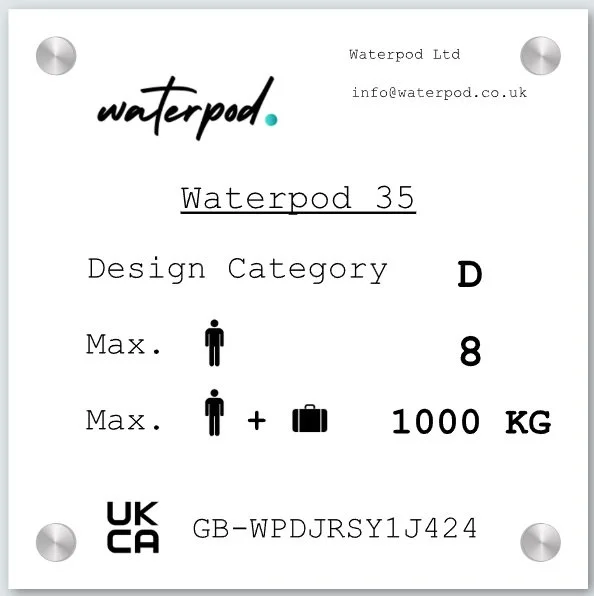
Every Waterpod is designed, built and certified as a Category D vessel, assigned a vessel registration number, and has a vessel builders plaque installed, bearing our internationally registered Manufacturers Identification Code (MIC).
What buyers really want
From the point of view of a future owner, certification gives you three major benefits.
1. Controlled risk and clear liability
You do not want to be the person trying to explain, after an incident, why you chose a floating sauna that was built cheaply, but not built and documented properly.
Certification does not eliminate all risk, but it helps show that the vessel was not thrown together casually - and places primary liability onto the builder who certified its compliance. It indicates that the builder has followed a recognised product compliance route rather than leaving key design and conformity questions to chance.
2. Approval and due diligence ease
Commercial buyers rarely operate in a vacuum. They may need comfort from insurers, navigation authorities, landlords, harbour teams, local authorities, or internal risk committees.
The MCA notes that insurers may require compliance with relevant safety equipment requirements as a condition of cover. Inland commercial operation may also involve licensing and navigation authority requirements, and the Inland Waters Small Passenger Boat Code is used as a recognised framework for small commercial vessels on inland waters.
A properly certified vessel will not solve every approval issue on its own, but it puts you in a far better position than a vague or piecemeal solution.
3. Reputational protection
If you are a premium hotel, a respected marina, or a local authority managing a public waterfront, you do not want a visibly makeshift installation that raises questions the moment someone asks who built it and what standards it meets.
A professionally built, certified vessel gives confidence to partners, guests, internal decision-makers, and stakeholders. It feels like a real asset, not a workaround.
Why this matters particularly for hotels, marinas and councils
For hotels and resorts
You want an amenity that enhances the guest experience and strengthens your brand, not something that creates awkward questions from insurers or risk managers.
A certified vessel is easier to defend internally and easier to explain externally.
For marinas and waterside operators
You want confidence that the operator is bringing in something professionally built and commercially credible, not something that becomes your problem later.
A certified vessel suggests a more serious manufacturer and a more serious operating proposition.
For councils and public bodies
You are not just evaluating a wellness concept. You are evaluating public risk, public perception, and operational competence.
A certified vessel helps demonstrate that the proposal starts from a proper marine platform rather than an untested floating structure.
What buyers should ask, without getting lost in technical detail
A sensible buyer does not need to become an expert in boat regulation. They just need to ask a few direct questions:
Was this vessel built for the UK market?
Has this been certified as compliant by the builder to meet UKCA RCR standards or other standards?
Can you provide the declaration and supporting documentation?
Have you designed this for commercial deployment on UK inland waters?
Have you done this before, or are we effectively the test case?
Those questions are usually enough to separate a serious supplier from a weak one.
Why many UK operators prefer a UK builder
For a hotel, marina, club, estate or local authority, the question is not only whether a floating sauna looks good or meets the right standard on paper. It is also whether the supplier is set up to support the asset properly once it is in the water.
That is one of the practical advantages of working with a UK builder.
Waterpod is based in the UK, designs for the UK market, and certifies to the UK Recreational Craft Regulations — the primary and most relevant framework for recreational craft placed on the market in Great Britain. That gives owners confidence that the vessel has been developed with UK requirements and UK operating conditions in mind.
There is also a practical ownership benefit. If a floating sauna ever needs attention under warranty — whether that is hull damage, corrosion-related issues, or a failure of a component or onboard system — proximity matters. A local builder can often attend site quickly and resolve issues in days rather than weeks.
That is especially important with floating assets, where warranty arrangements are not always as simple as they are for land-based products. In most cases, vessel warranties are return-to-base, requiring the owner to ship the vessel back to the builder for warranty repairs at their own cost. This can become highly disruptive and expensive if a vessel needs to be transported overseas for repair. For a UK owner, buying from a UK builder reduces that risk and makes after-sales support much more straightforward.
For many commercial operators, that combination matters: a vessel designed for the UK, certified for the UK market, and supported by a company that can realistically be on site quickly when needed.
Final answer
If you are buying a floating sauna for use in the UK, certification matters because it reduces risk, improves credibility, supports due diligence, and makes commercial deployment easier.
And if you are buying for a hotel, marina, club, estate, or council, those things matter more than almost anything else.
Frequently Asked Questions
-
Yes. UKCA certification matters because it supports safety, credibility, due diligence, legal and regulatory compliance for a floating sauna being sold and operated in the UK market.
-
Because it is designed for the UK market, aligned with the UK regulatory framework, and usually supported more easily by a local builder after installation.
-
For many UK commercial buyers, yes. Waterpod’s advantage is that it is UK-based, certifies to UK RCR, and can usually provide faster, more practical local aftercare than an overseas supplier.
-
It means the warranty may depend on the product being returned to the builder or original facility for certain repairs. This is a standard warranty requirement for all vessels sold in the UK and Europe.
For a floating sauna, that can be a major issue because transport and lifting costs can be substantial. Buyers should always ask how warranty repairs are actually handled in practice: on site, regionally, or back at the builder’s premises.
-
Because Waterpod is UK-based, designs for the UK market, certifies to the UK Recreational Craft Regulations, and can provide local support after handover. For a UK owner, that means a vessel designed around the market it will actually operate in, backed by a builder who can usually get to site quickly if needed.
-
Because floating assets can be difficult and expensive to move or repair. If there is hull damage, corrosion, or a failure of a component, speed of response matters.
A UK-based builder is far more likely to be able to attend site quickly and resolve an issue with minimal disruption. By contrast, a distant supplier may involve longer delays, remote diagnosis, or costly transport if return-to-base support is required.
This is a practical commercial point rather than a legal one, but for many owners it is one of the most important.
-
Ask these direct questions:
Was it designed for the UK market?
What conformity route does it have?
Can you provide the declaration and supporting documentation?
Is it designed for commercial deployment on UK inland waters?
Who will support us if something goes wrong after installation?
Those questions align with the manufacturer obligations in the UK framework, including conformity assessment, technical documentation, labelling, and instructions and safety information.
-
A serious buyer should not assume that.
Once it is a floating product being sold and used on water, questions arise around design, safety, documentation, conformity and suitability for the intended use.
A DIY project putting a sauna on a pontoon is unlikely to be compliant and certifiable as a vessel and may be difficult to insure, or unlawful to install or operate.
That is why buyers should treat it as a marine product, not just a land sauna in a different setting.
-
Because you are not just buying a sauna. You are introducing a commercial asset on water that may be used by guests, members or the public. In practice, buyers in that position care about safety, liability, insurability, reputational risk and whether the proposal will withstand scrutiny from internal stakeholders and external authorities. The UK framework exists to support safe products being placed on the market.
Disclaimer:
This article is for general information only and does not constitute legal or professional advice. Regulations and requirements may change and can vary depending on the vessel and its intended use. Readers should obtain appropriate professional advice before relying on this information. While prepared in good faith, no representation or warranty is given as to accuracy or completeness, and no liability is accepted for reliance on it.