Do you need planning permission for a floating sauna in the UK?
In short: while local rules vary, if you’re using a certified vessel (a boat) on a mooring with commercial usage rights, usually no planning permission is required.
Most floating saunas fall into one of two categories — and knowing which one you're working with makes the planning question more straightforward.
If you're installing an RCR-certified navigable vessel (like Waterpod's Drift), you're mooring a boat. Boats don't need planning permission — they just need somewhere permitted to moor. The question isn't "can I build this?" but "can I moor it here for commercial use?".
If you're building a static structure on a pontoon, you're constructing a building on water, and by default, standard planning rules apply.
This article explains the difference, what it means for your project, and how to get certainty without unnecessary hassle.
The Simple Framework
Planning rules are notoriously vague, especially in niche areas like commercial vessel operation. We have conducted extensive research into this area, and in in short, the rules of thumb are:
✅ Sauna Type: Certified vessel (like Waterpod Drift) → No planning permission for the vessel itself
❌ Sauna Type: Static structure (sauna on a pontoon)→ Planning permission required
✅ Mooring with commercial usage right → No planning permission to operate on the mooring
❌ Mooring for leisure or residential use only → Planning permission required
✅ Temporary use → Up to 28 days without permission often possible (rotate locations every months)
✅ If in doubt, get certainty → Certificate of Lawful Development (£100-£200)
✅ If you get it wrong → Typically 3-6 months to obtain retrospective permission or move the vessel.
Check 1: Boat vs. Floating Structure
The planning permission question first hinges entirely on whether your floating sauna is classified as a vessel or a structure.
RCR-Certified Navigable Vessels (AKA Boats, like Drift)
The planning assumption for certified vessels: No permission required. ✅
A floating sauna built as an RCR-certified navigable vessel — such as Waterpod's Drift — is a certified boat. This means it can be moored wherever a boat can be moored (with the mooring owner's permission), just like any other vessel.
If planning permission isn't required for a boat at that mooring, it's unlikely to be required for a certified floating sauna. The vessel itself is regulated under maritime law (the Recreational Craft Regulations), not planning law.
This is a major advantage for hospitality operators. You're mooring a boat, not installing a structure or constructing a building. The regulatory pathway is cleaner, faster, and more predictable.
-
Mooring, West India Pier, Cuba Street, PA/05/01322 — 30 Nov 2005
The official committee materials explicitly distinguished a navigable vessel from a non-propelled raft or pontoon houseboat, and the approval was framed around that distinction, which helps support the lower-risk planning position for a genuine navigable vessel.
Link: https://democracy.towerhamlets.gov.uk/mgAi.aspx?ID=3298Chelsea Yacht and Boat Company Ltd v RBKC — 1 Nov 2024, APP/K5600/C/24/3345933
Approved
The council determined that planning was needed, however the inspector quashed enforcement on appeal because the two larger houseboats did not amount to a material change in the character of the existing residential houseboat mooring use. This is strong support for the proposition that vessel-based use in an established boating context does not automatically trigger fresh planning control.
Link: https://acp.planninginspectorate.gov.uk/ViewDocument.aspx?fileid=59710197Chelsea Yacht and Boat Company Ltd v RBKC — 1 Nov 2024, APP/K5600/X/24/3345934
In the paired lawful development certificate appeal, the inspector confirmed that mooring up to 60 residential houseboats, including the disputed vessels, was lawful, which is stronger support than discretionary planning permission.
Link: https://acp.planninginspectorate.gov.uk/ViewDocument.aspx?fileid=59710197Thornham Marina floating pod enforcement appeal — 16 Jan 2024, APP/L3815/C/22/3311612
The inspector found that the floating pod-style units were not “buildings” as a matter of fact and degree, which supports the argument that a genuine vessel unit is less likely to be treated as a static building for planning purposes.
Link: https://acp.planninginspectorate.gov.uk/ViewDocument.aspx?fileid=55663421
Static Pontoon Installations
The planning assumption for static structures: Permission likely required. ❌
A floating sauna built on a static pontoon — one that's not a certified, navigable vessel — falls outside the RCR framework entirely. The legal test for when a boat becomes a "structure" requiring planning permission is whether it has sufficient permanence and is affixed to the land (Tristmire Ltd v Mew [2011] EWCA Civ 912).
Local planning authorities may treat it as a new building or change of use, requiring:
Full planning application
Building control approval
Potentially, environmental impact assessments
-
Riverine, Taggs Island, Hampton — 19 Jul 2011, APP/L5810/X/11/2151249
This supports the argument that where a floating structure has substantial permanence and physical attachment to the site, works to it can be treated as operational development rather than mere vessel use, making planning permission more likely to be required.
Link: https://planningjungle.com/wp-content/uploads/2151249-Appeal-Decision-Notice.pdfLower Upnor residential vessel and access works — 24 Jun 2024, APP/A2280/C/23/3315311
The inspector upheld enforcement against a large, blocky, building-like floating structure with associated piles, jetty and access works, which is strong support for the proposition that a pontoon-style floating sauna is likely to fall within planning control.
Link: https://www.frindsburyextra-pc.gov.uk/shared/attachments.asp?f=9dbd9652-7195-4b14-a72b-adba913f0aa0.pdf&o=House-Boat-3315311---Appeal-Decision.pdfSlipstream, The Boatyard, Clarks Wharf — 12 Jul 2024, APP/Z3635/C/23/3314071
The inspector made clear that even if a floating object is not itself a building, occupation of the mooring can still amount to a material change of use of the land, so planning permission may still be required for a static floating structure.
Link: https://acp.planninginspectorate.gov.uk/ViewDocument.aspx?fileid=58146197
Check 2: Mooring Rights and Commercial Use
Even with a certified vessel like Drift, planning permission may still be triggered — but not for the boat itself. The issue is the mooring's permitted use. This means that you may be able to moor it there, but not use it commercially.
Commercial vs. Residential/Leisure Moorings
If your mooring is designated for:
Residential use only, or
Private leisure use only
...then using it for commercial purposes (like operating a paid-entry floating sauna) constitutes a change of use. This change of use requires planning permission — not for the vessel, but for the plot.
However, if the mooring:
Already has rights for commercial use, or
Is in a commercial marina with flexible use permissions
...then in most cases, planning permission is unlikely to be required. You're simply mooring a commercial vessel at a commercial mooring — exactly what the site is zoned for.
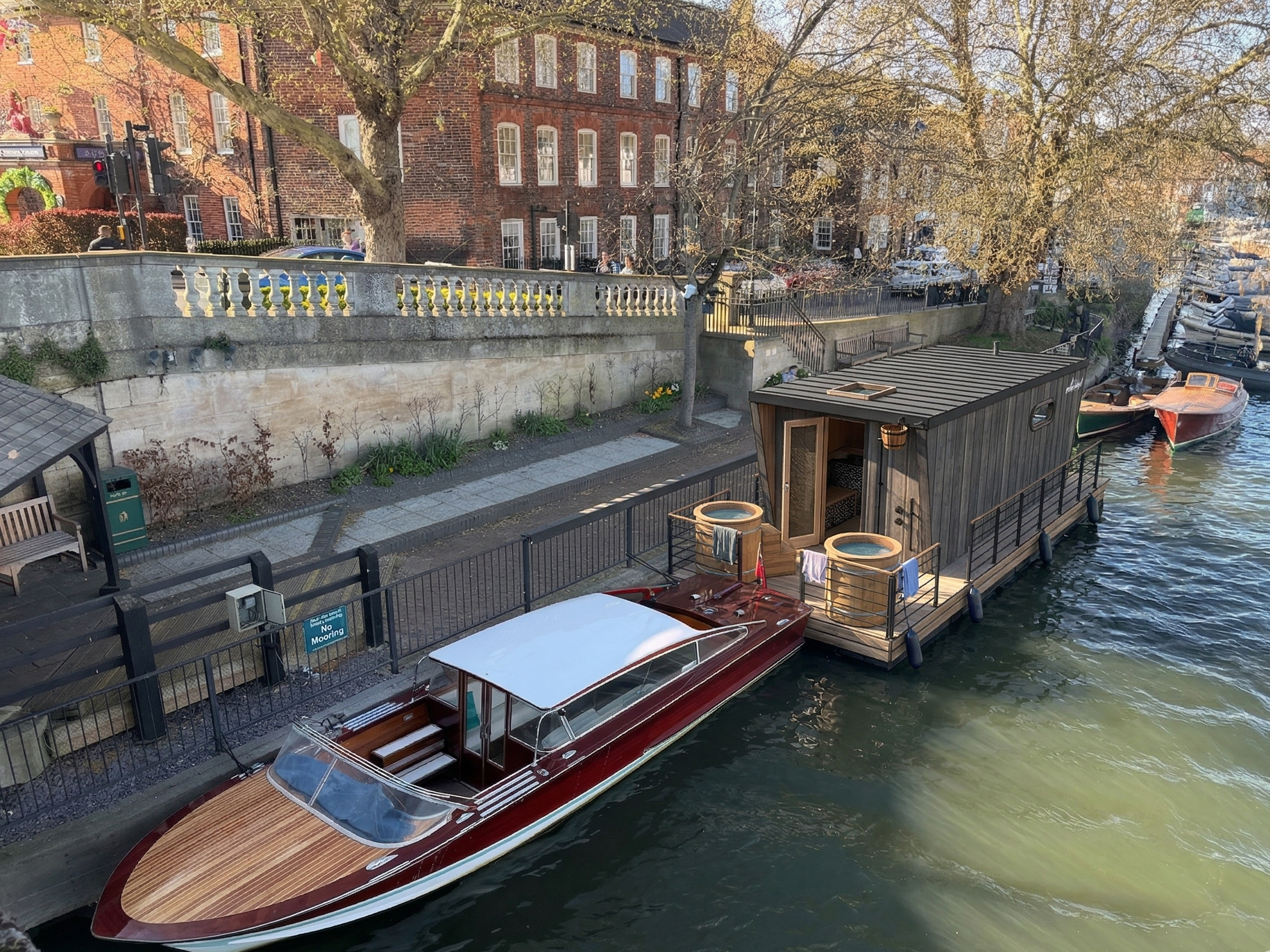
In Practice: The Waterpod Drift Advantage
Waterpod Drift is designed as a fully certified recreational vessel (a boat). This means:
No planning permission required for the floating sauna itself in most cases
Faster deployment — you're mooring a boat, not constructing a building
Flexibility to relocate — if you find a better mooring or want to relocate regularly
Clearer regulatory pathway — maritime law, not building regulations
The only planning hurdle is ensuring your mooring permits commercial use. If it does, you're clear to proceed.
If it doesn't, you'll need to apply for change of use permission for the mooring — but this is typically far simpler and faster than applying for planning permission to construct a new building.
Why This Matters
The distinction between vessel and structure isn't academic — it's the difference between:
Minutes to moor (certified vessel at permitted mooring)
Months or years of planning battles (static structure requiring building consent)
For hospitality operators who want to move quickly, this regulatory clarity is everything. A certified vessel gives you the fastest route to market.
What About Your Specific Location?
Planning rules can vary by location and local planning authority. Coastal areas, national parks, Areas of Outstanding Natural Beauty (AONBs), and conservation areas may have additional restrictions.
Our recommendation:
Confirm your mooring's permitted uses (check the lease or ask the marina/landowner)
Check with your local planning authority whether commercial vessel mooring requires permission
If in doubt, submit a Certificate of Lawful Development application — a low-cost way to get formal confirmation
A practical workaround: In some locations, it's possible to use a mooring for commercial purposes on a temporary basis — sometimes up to 28 days in any 90-day period — without requiring planning permission for change of use. If you have access to multiple nearby locations, a certified vessel like Drift can be easily relocated between them, effectively extending your operating window while remaining compliant with temporary use limits. This approach works particularly well for seasonal operations or proof-of-concept deployments.
But in the vast majority of cases, if you have a mooring that permits commercial vessel use, and you're installing a certified vessel like Drift, planning permission is not required.
In an unfortunate worst-case scenario
"Prepare for the worst and hope for the best" — despite good faith research, planning policy in this field is often a grey area. Boat owners occasionally find themselves unexpectedly on the wrong side of the line and even receive a planning enforcement notice.
If this happens, all is not lost. Situations vary, but as a guide, if you find out late that planning permission is required, the general process is:
Retrospective planning application: If no notice has been served yet, submit as soon as possible. The council typically holds off on enforcement while considering the application (2-3 months). Cost: £500-£1,000.
Enforcement notice served: If the council believes you are in breach, an enforcement notice letter will be served typically with 28 days before taking effect. From this point you will typically have 3-6 months to comply (total: 4-7 months from initial notice for a change of use).
If you recieve a notice: You must decide whether to (a) comply with the notice timeline (vacate within 3-6 months), (b) comply and submit retrospective application and , or (c) appeal the notice. Only an appeal suspends the enforcement notice — a retrospective application does not stop the clock.
Appeal: If you appeal within 28 days of the notice being served, the enforcement notice is suspended throughout the appeal process (typically 9-12 months). There is no fee to appeal, but professional consultant fees may apply.
Timeline: If appealing, operations can typically continue for 9-12 months during the appeal process. If the appeal is dismissed, the compliance period then runs from the enforcement notice (3-6 months). This is a total of 12-18 months, during which time operations may continue. Operations must then stop and/or the boat may need to be moved to an alternative location.
Important: We do not endorse non-compliance with planning requirements, we do not provide planning advice and the above is provided as guidance only for circumstances where planning conditions were genuinely misunderstood, ambiguous or changed. Always seek planning law advice if in doubt.
Summary
For RCR-certified vessels (e.g. Waterpod Drift):
Planning permission unlikely for the vessel itself
Check mooring use rights — commercial use must be permitted
If mooring permits commercial vessels, you're good to go
An engine can be fitted so you can easily drive it between locations if needed.
For static pontoon saunas:
Likely classified as a structure, not a vessel
Planning permission probably required
Slower, more complex regulatory pathway
The fastest, cleanest route to launching a floating sauna is to choose a certified vessel and moor it at a commercially-permitted location.
Disclaimer:
The information in this article is provided in good faith based on our understanding of UK planning and maritime law, and our observations across multiple UK locations at the time of writing (April 2026). Planning regulations are complex, vary significantly by location and local authority, and involve many grey areas — particularly for niche applications like floating saunas. We strongly recommend consulting with your local planning authority, a planning consultant, or a solicitor specializing in maritime or planning law for specific advice on your project. No liability is accepted for any errors or omissions